반응형
1. 문제
A DNA sequence can be represented as a string consisting of the letters A, C, G and T, which correspond to the types of successive nucleotides in the sequence. Each nucleotide has an impact factor, which is an integer. Nucleotides of types A, C, G and T have impact factors of 1, 2, 3 and 4, respectively. You are going to answer several queries of the form: What is the minimal impact factor of nucleotides contained in a particular part of the given DNA sequence?
The DNA sequence is given as a non-empty string S = S[0]S[1]...S[N-1] consisting of N characters. There are M queries, which are given in non-empty arrays P and Q, each consisting of M integers. The K-th query (0 ≤ K < M) requires you to find the minimal impact factor of nucleotides contained in the DNA sequence between positions P[K] and Q[K] (inclusive).
For example, consider string S = CAGCCTA and arrays P, Q such that:
P[0] = 2 Q[0] = 4
P[1] = 5 Q[1] = 5
P[2] = 0 Q[2] = 6
The answers to these M = 3 queries are as follows:
- The part of the DNA between positions 2 and 4 contains nucleotides G and C (twice), whose impact factors are
3 and 2 respectively, so the answer is 2.
- The part between positions 5 and 5 contains a single nucleotide T, whose impact factor is 4, so the answer is 4.
- The part between positions 0 and 6 (the whole string) contains all nucleotides, in particular nucleotide A whose
impact factor is 1, so the answer is 1.
Write a function:
vector<int> solution(string &S, vector<int> &P, vector<int> &Q);
that, given a non-empty string S consisting of N characters and two non-empty arrays P and Q consisting of M integers, returns an array consisting of M integers specifying the consecutive answers to all queries.
Result array should be returned as an array of integers.
For example, given the string S = CAGCCTA and arrays P, Q such that:
P[0] = 2 Q[0] = 4
P[1] = 5 Q[1] = 5
P[2] = 0 Q[2] = 6
the function should return the values [2, 4, 1], as explained above.
Write an efficient algorithm for the following assumptions:
- N is an integer within the range [1..100,000];
- M is an integer within the range [1..50,000];
- each element of arrays P and Q is an integer within the range [0..N - 1];
- P[K] ≤ Q[K], where 0 ≤ K < M;
- string S consists only of upper-case English letters A, C, G, T.
- 문자열 S가 주어진다.
- S는 A,C,G,T 문자로 이루어져 있다. 각 문자는 1, 2, 3, 4 정수로 대응된다.
- 문자열 S에 대한 index P와 Q가 주어질 때, S[P], S[Q] 사이에 있는 문자 중 가장 작은 문자가 무엇인지 찾는다.
2. 매개변수 조건
- 문자열 S의 길이(N): 1 ~ 100,000
- P와 Q의 갯수(M): 1 ~ 50,000
- P와 Q의 값: 0 ~ \( (N-1) \)
- \( P[K] \leq Q[K], (0 \leq K < M) \)
- 문자열 S를 구성하는 문자 종류 : A, C, G, T
3. 코드 (C++)
주어진 범위(P, Q)에서 가장 작은 값을 찾는다.
vector<int> solution(string &S, vector<int> &P, vector<int> &Q) {

    vector<int> result = {};
    for(size_t M = 0; M < P.size(); M++)
    {
        //주어진 범위 안에서 가장 작은 문자 검색
        char letter = 'T';
        for(int idx = P[M]; idx <= Q[M]; idx++)
        {
            if(S[idx] < letter) letter = S[idx];
        }

        //찾은 값 저장
        if(letter == 'A') result.emplace_back(1);
        else if(letter == 'C') result.emplace_back(2);
        else if(letter == 'G') result.emplace_back(3);
        else result.emplace_back(4);
    }

    return result;
}
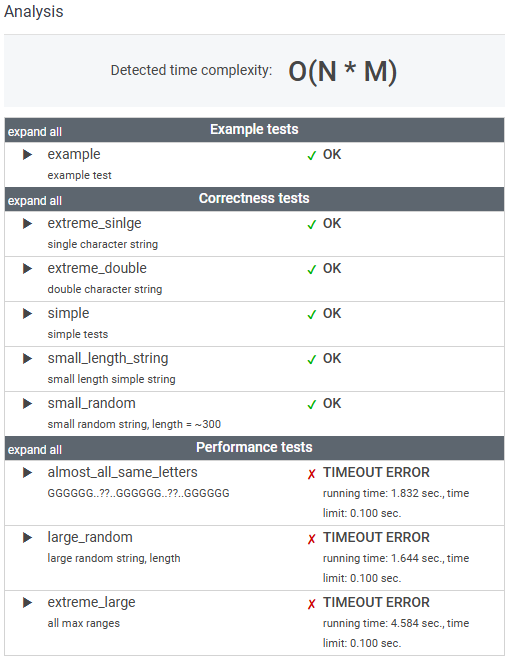
4. 결과
반응형
'Algorithm Problem > Codility' 카테고리의 다른 글
| Lesson 5. Perfix Sums - MinAvgTwoSlice #1 (0) | 2024.11.03 |
|---|---|
| Lesson 5. Perfix Sums - GenomicRangeQuery #2 (속도 개선) (0) | 2024.10.26 |
| Lesson 5. Perfix Sums - CountDiv #2 (속도 개선) (0) | 2024.10.21 |
| Lesson 5. Perfix Sums - CountDiv #1 (0) | 2024.10.21 |
| Lesson 5. Perfix Sums - PassingCars #4 (번외-prefix sums) (0) | 2024.10.13 |